Mar 10, 2026
Why Website Visitors Don’t Convert (AI Can Fix It)
The modern web is rich with information and context but lacks a true guided conversion layer that sits on top.

The modern web has a conversion problem, and nobody's been willing to name it clearly.
We've built incredible infrastructure for moving information around. Search engines that know everything. Recommendation algorithms that learn your taste. Analytics that track every pixel of movement. And yet — when someone lands on your website actually wanting to buy something, wanting to make a decision, wanting to move forward — the whole thing falls apart. They see a product page. Features. A price. Then they leave.
Understanding why website visitors don't convert requires looking past the obvious answers. The problem isn't information scarcity. It's something more fundamental: we've never built a real conversion layer. Not a marketing funnel. Not a sales pitch. An actual conversion layer. The infrastructure that understands the gap between someone's interest and their commitment, and knows how to close it.
For ten years, we've thrown AI at this. Most "AI to increase website conversions" has meant smarter chatbots — faster FAQ engines wrapped in neural networks. They're faster. They sound more natural. Every site with budget has one. But they're solving the wrong problem entirely. A customer doesn't convert because you told them the thread count of your sheets or how fast your API responds. They convert because you figured out why they were hesitant about the price. Why they worried about fit. Why they were looking at a cheaper option. Why they thought they might be making the wrong choice.
Conversion happens when you address the hesitation, not the specification.
That's the entire distinction.
After watching what actually moves the needle on customer decisions — not engagement metrics or question volume, but real business outcomes — we realized the whole AI assistant category needed to evolve. That's what led us to what we believe is genuinely new: Karley is the conversion layer for the modern web. But it's not powered by a chatbot, or an FAQ engine, or a shopping assistant. It's powered by something we call a Conversational Intuition Engine.
Understanding the Conversion Layer
A conversion layer bridges the gap between interest and decision. It's what a great salesperson does, but digital: recognize the moment a customer is uncertain, understand what that uncertainty really means beneath the surface, speak to it directly.
Most tools today aren't built for this.
Product pages? Information delivery. Live chat? Support. Email? Asynchronous. Advertising? Awareness. Each serves a purpose. None of them handle what actually happens in those critical moments before someone commits to a purchase, commits to a service, or decides to move forward.
The conversion layer fills that gap. It operates in the exact moment when it matters most: when someone is evaluating, doubting, deciding. It doesn't wait for a typed question. It reads what's happening beneath the surface and intervenes with real understanding.
This applies everywhere. Not just e-commerce. SaaS. Professional services. B2B. Energy. Healthcare. Anywhere humans make meaningful decisions on a website.
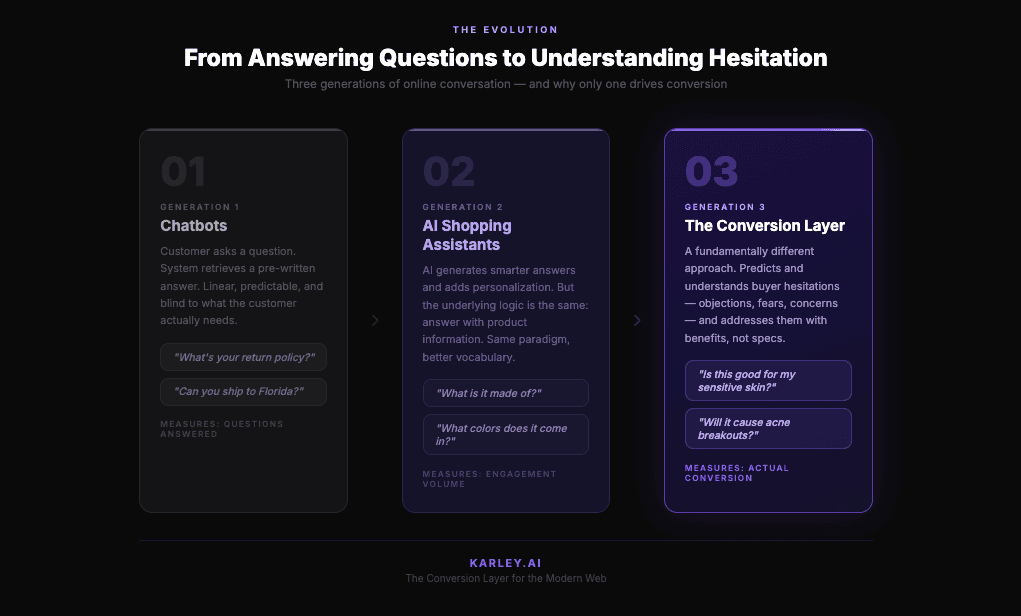
How to Convert Hesitant Buyers: The Conversational Intuition Engine Framework
A Conversational Intuition Engine (CIE) is an AI system that doesn't just answer questions. It predicts, reads, and resolves the unspoken objections between interest and decision.
Traditional chatbots? They follow a script. Question in, answer out, conversation progresses. Linear. Predictable. Blind to what's actually happening.
A CIE starts differently. With observation. It reads the conversation itself — how someone phrases a question, what they ask about repeatedly, what makes them anxious, what they're really getting at beneath the literal words. The hesitations. The patterns that precede a bounce. Then it intervenes.
It's not about raw processing power or better language models. It's a completely different philosophy about what conversational AI for conversion should optimize for. A CIE optimizes for understanding doubt instead of retrieving answers. For resolving objections instead of serving information. For moving someone from "interested but unsure" to "decided and committed."
We're not trying to make better generic FAQs with AI. Instead we want to enable conversations that actually understand what's stopping people from buying — why customers don't buy on your website, their fears, their concerns — and help them move past it. That's what a CIE does.
The Six Pillars of Conversational Intuition
These came from us putting ourselves in our customers' shoes obsessively. "What do we actually need before buying a product? What would make us convert?" We iterate. We test. We focus on what genuinely addresses doubt, not just answers questions.
1. Signal Detection Over Script Following
A CIE doesn't follow a script. It looks to observe. It thinks about what people would hesitate about before making a final decision. It looks for context and signals showing that it is making the right assumptions. It looks to always be getting better based on those signals. In other words, it tries to replicate the body language a shopper shows in in-person environments.
2. Hesitation Mapping Over Feature Description
Every product has features. Customers can Google the specs themselves. What they actually need is someone who anticipated their doubts.
Our breakthrough: stop training the system to answer questions. Start training it to map doubts.
For a $200 skincare product, the hesitation isn't about ingredients. It's about whether it's genuinely worth it versus the $30 alternative or whether it will cause acne. For SaaS, it's not the feature list. It's "will this actually integrate into my workflow without breaking something?" A CIE becomes an expert in the specific doubts of your business, your customers, your category.
3. Contextual Adaptation Over One-Size-Fits-All
Most companies get this wrong. They think there's one answer to conversion.
There isn't.
Some customers convert on social proof. Others on storytelling. Others just need the right guarantee at the right moment. A CIE recognizes this. A first-time buyer with serious purchase anxiety needs a completely different conversation than someone buying their second time. A price-sensitive buyer needs different messaging than someone who's already picked you and just needs confirmation.
This isn't personalization. Personalization is putting someone's name in a template email. This is reshaping the entire conversation based on what's happening beneath the surface, in real time. While it’s early, we recognize getting this right is important and we hope to be able to invest time and money here.
4. Outcome Measurement Over Interaction Volume
The chatbot industry measures success wrong: "How many people used it? How many questions did it answer?" Those metrics are meaningless if the customer doesn't convert. In customer service, companies like Sierra.AI flipped the script to focus on resolutions rather than activity.
A CIE measures one thing: did the customer move forward?
Everything else is secondary. Every message that doesn't move conversion gets tested, refined, or replaced. Every interaction teaches something new. Every conversion is a signal. Every bounce is data.
5. Empathy Through Data Over Empathy Through Guesswork
Here's something odd about building a CIE: the more data-driven you become, the more empathetic it feels.
When you measure doubt, map objections, and test messaging at scale, you actually understand what customers care about. You stop guessing. You see real patterns in real behavior. That’s our goal.
Most AI feels empathetic through simulation — trained to sound understanding, to mirror emotions. A CIE is empathetic because it learned. It understands you because it actually studied what matters to people like you in situations like yours. The empathy isn't performed. It's earned.
6. Universal Application Beyond E-commerce
A law firm's website doesn't convert potential clients until someone addresses the unspoken questions: Can I trust this firm? Are they too expensive? Will they understand my specific situation?
A solar company doesn't convert until hesitations about cost, reliability, and installation get addressed in real time.
B2B SaaS doesn't convert until concerns about implementation effort and switching costs are genuinely resolved.
Anywhere humans make real decisions on a website, doubt exists. Anywhere doubt exists, a conversion layer matters. This isn't an e-commerce feature. It's decision-making infrastructure.
How We Got Here
It’s been a journey so far. Karley actually started as a lead gen platform to score leads, then evolved to trying to automate the process of creating FAQs. We iterated. We tested. We asked ourselves over and over, "What would actually make me convert? What would really move me forward?" We focused on what addresses doubt, not just answers questions.
Then we hit a wall. The entire paradigm of "answer questions better" was backwards.
The real question wasn't how to retrieve information more intelligently. The real question was: "What's actually holding people back? What unspoken doubts keep someone from committing?" Once we started asking that, everything changed. It was humbling because it meant our whole initial approach — better chatbots, smarter AI, faster information retrieval — was solving the wrong problem. You can slap machine learning on a broken approach and just make the broken thing faster and more convincing. That doesn't fix it.
So we stepped back. We rebuilt from scratch. Stopped asking "How do we answer customer questions more intelligently?" Started asking "What does it actually take to move someone from interested to committed?"
The answer was a Conversational Intuition Engine.
Not a better chatbot. Something actually different.
What This Means
The companies that win in AI-powered conversion are the ones willing to admit the old approach is broken and bold enough to build something new. That something is a real conversion layer — infrastructure built specifically to understand and resolve the unspoken doubts that stop people from moving forward.
Karley is that conversion layer for the modern web.
Not a tool for answering questions more intelligently. A tool for understanding doubt more deeply. That's the future. That's what AI actually does when it's built to help people decide.